Save And Earn

Making Your Money Go Further

Cost of Living Crisis Survey 2022

October 3, 2022 By Erica Hughes This post may contain affiliate links

cost of living
Photo by Etienne Girardet on Unsplash

Living expenses are rising, wages are not keeping up with the increases. A cost of living crisis is a situation in which the cost of necessities like housing, food, and transportation becomes so high that people cannot afford them or have to cut back considerably to do so.  This is a global phenomenon effecting every country in the world.  However, some countries are more effected than others because of geography, history and the actions of the present day government.  For example, in the UK decisions on support were delayed due to a lenghty leadership changeover in the ruling party.  Then a disastrous mini budget by the new leader caused the pound to plummet, so increasing the cost of imports.

6000 People Surveyed Reveal How they will be Impacted by the Cost of Living Crisis & The Changes they will be Forced to Make to Manage Their Finances; including Turning Heating off, Cancelling TV Subscriptions, Borrowing More, Saving Less and Selling Personal Items

– 94% (UK) and 92% (US) of people say cost of living increases will have an adverse effect on household finances with 26% (UK) and 20% (US) saying it will have an extremely detrimental effect.
– 74.6% (UK) and 52% (US) feel that their government isn’t supporting them throughout the crisis.

The cost of living has become a global issue that is inescapable for many people. Thanks to the ongoing COVID pandemic, the energy crisis, supply issues, fuel shortages and price increases, and the atrocities of war in the Ukraine, people around the world are facing price rises across multiple industries, and things don’t seem to be getting any better.

SellCell.com—a money-saving site that helps customers find the best deals for their tech —wants to understand how the cost-of-living crisis is going to affect the everyday person in both the UK and the US, and gain knowledge on the main lifestyle changes people will be forced to make in order to accommodate the ever-increasing price hikes they face.

In order to obtain such information, SellCell has surveyed 3000 UK and 3000 US citizens to find out exactly how the cost-of-living crisis will affect them.

Purpose of Survey
SellCell surveyed 6,000 respondents, split equally between the UK and the US. The survey asked respondents across ten questions, how serious the financial effects of the cost-of-living crisis will be for their household, where they will make savings and cutbacks, whether they will take on additional work, if they worried about forthcoming Christmas spending, and whether they feel supported by their government.

The data compiled through the survey will give insight into how the cost-of-living crisis will play out for millions of people across the globe.

Summary of UK Findings
– 94.1% of people say cost of living increases will have an adverse effect on household finances with 26.1% stating the cost-of-living crisis will seriously affect their household finances, while only 5.9% stated that the crisis will have no effect on them at all.
– 70.2% of UK respondents say that reducing heating use, or turning it off completely, will be their primary measure to cut costs. 62.4% state that they aim to reduce electricity use in order to make further savings.
– In terms of day-to-day spending, 56.8% of UK respondents said they would shop in a discount or budget supermarket, while 38.9% will cancel subscriptions to the likes of Netflix and Sky, and 38.4% of people will buy less clothing. Only 9.1% will consider selling their car to save cash.
– To reduce spend on luxuries, 52.0% of respondents said they would reduce the number of times they go out, and 51.4% of people will ditch the meals out and takeaways. 41.4% state they will avoid buying the latest tech.
– Most people—55.8%—don’t plan to supplement their earnings by making extra cash. 24.1% say they will sell some possessions like clothing and jewellery, and 20.3% will sell old tech to make money.
– With Christmas now looming on the horizon, 24.8% of people—representative of almost a quarter of the population of the UK—are extremely worried about the pressures of Christmas spending.
– A huge 71.8% of UK respondents will reduce Christmas spending this year.
– 74.6% of UK respondents state they do not feel the government is supporting them throughout the cost-of-living crisis.
– 22.7% of those in the UK stated they will need to take out a loan or a new credit card to cover their living costs.
– 33.5% of people in the UK state that they have no savings to cushion the blow from the crisis, and for those that do have savings, 21.4% of them will need to utilise those savings to make ends meet.

Summary of US Findings
– 92% of people say cost of living increases will have an adverse effect on household finances and 20.0% of US participants stated that the cost-of-living crisis will seriously affect their household finances, with 8.0% saying it won’t have any effect at all.
– 32.7% of those in the US will reduce car journeys, walk, or cycle, in order to save money in the home. 36.4% of respondents said they won’t need to do anything to save money in the household.
– Shopping at a budget supermarket is how 43.6% of US participants will stomach the cost of day-to-day spending to save money. 35.8% of US citizens will buy fewer clothes to ease financial pressure.
– 47.0% of US respondents state that they’ll cut back on going out or entertainment in order to save on the cost of luxuries, while 41.5% will stop eating at restaurants or ordering takeaways. 4.8% of those who answered are considering selling their car and getting public transport instead.
– 58.8% of respondents in the US won’t need to supplement their salary to make extra cash and cope with the rising cost of living. 18.0% will take on a second job or start a side business, and 10.8% will sell old tech to cover costs.
– 23.5% of US participants aren’t worried about the forthcoming pressures of Christmas spending, with 12% being moderately worried, and 11.5% being extremely worried.
Christmas spending looks set to drop in the US this year, with 57.3% of people reducing outgoings during the holiday season.
– 52.0% of US respondents don’t feel that they’re getting enough support from the US government.
– 24.8% of the US will need to take out a loan or use a credit card to cover the expense of the cost-of-living crisis.
– Unfortunately, 18.7% of US respondents have no savings to fall back on, while 38.3% of people will still be able to save money each month.

Main Findings

SellCell’s findings, in general, paint a harrowing picture. It is plain to see that the cost of living is causing concern for many people who are feeling the brunt of the crisis. Below, it broke data down into survey questions and the responses thereto.

Filed Under: Budgeting

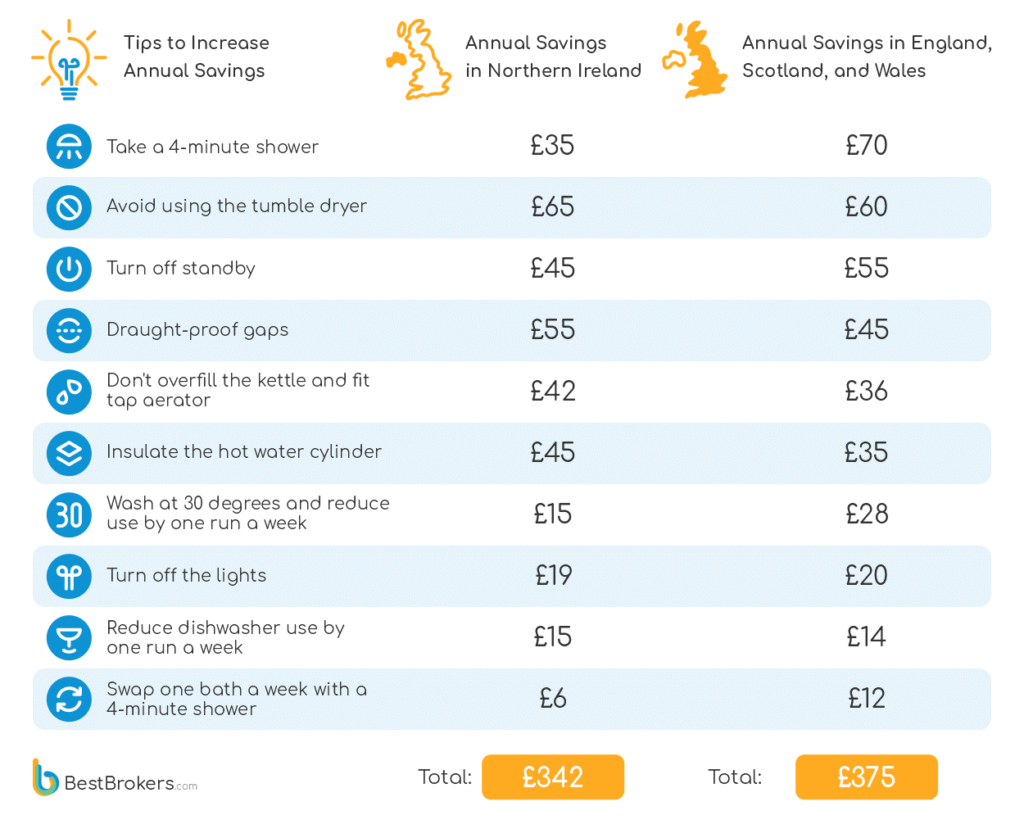
Brits Could Save Up to £375 on Energy Bills by Building a Few Simple Habits

September 21, 2022 By Erica Hughes This post may contain affiliate links

The cost of energy has gone up in recent years and this is causing a lot of people to be scared. There are many different factors that contribute to the rising cost that set the rises in motion in the tail end of 2021.  Whilst the war in Ukraine hasn’t been the root cause of the problem, it hasn’t helped matters.  Lots of people are genuinely worried about how they will pay their bills in the coming year.  The government have helped a little, but prices have already risen too high for many on fixed or limited incomes.  There are ways to cut the cost though by being careful with energy consumption.

With rising food prices and inflation in August at 9.9%, just 0.2% lower than the 40-year high of 10.1% in July, thousands of households in the UK are now struggling to make ends meet. Adding fuel to the unfolding cost-of-living crisis, energy bills are soaring and many people fear they would need to choose between food and heating this winter. The new increase in energy prices is expected to come into effect in October, squeezing out an even larger portion of the income of millions of Brits.

According to Chancellor of the Exchequer, Kwasi Kwarteng, the UK is less vulnerable to the current gas crisis than most of Europe. Still, the rise in wholesale gas prices increases the electricity price cap set by industry regulator Ofgem. The system introduced by Theresa May’s government in 2019 capped the standard variable tariffs temporarily, promising affordable prices for gas and electricity. But it is now being adjusted quarterly and is forecast to be raised to £4,266 annually early next year – more than twice the current £1,971 set in April 2022. All this prompted the analyst team at BestBrokers to look into typical household appliances and their power consumption, aiming to answer the question how families can reduce their energy bill this season.

How to Save Money on Your Energy Bills

energy costs

What people can do to reduce their electricity bills is simply look at common household appliances that draw up the most energy. One of the easiest ways to save energy is by unplugging the appliances when they are not in use. You can also turn the lights off when you don’t really need them, make your house heatproof and install electricity usage monitors. Opting for energy-efficient models is also smart in the long term, although appliances with higher energy ratings are more expensive. The energy efficiency classes are from A to G, with those labeled A being the most energy-efficient and F and G-rated products waste the most electricity.

The standby mode, even though quite handy, still uses electricity. According to the UK-based Energy Saving Trust, we can save around £55 (£45 in Northern Ireland) a year if we turn the appliance or device off its standby mode. The savings have been estimated based on an electricity price of 28.3p/kWh (based on the April 2022 price cap) for England, Scotland, and Wales. Other methods for reducing energy bills include washing clothes at lower temperatures, avoiding the tumble dryer altogether, and using the dishwasher only when it is full.

Methodology

The displayed annual energy savings tips are for a typical three-bedroom home in England, Scotland or Wales that uses gas heating. Savings are calculated based on a gas price of 7.4p/kWh and electricity price of 28.3p/kWh (per April 2022 price cap), while water savings use average occupancy. The numbers for Northern Ireland use an oil price of 9.2p/kWh and an electricity price of 30.9p/kWh (as of July 2022).

Calculate the Potential Savings for Your Home

There are several things to keep in mind when assessing how much you could save from your energy bill every month. What appliances do you have in your home? Which ones are used regularly (once a day, twice a week, etc.)? Of course, while some appliances such as refrigerators are in use 24 hours a day, we use others just for a short period of time.

You need to calculate the hourly, daily, or monthly power consumption for every appliance based on its wattage, a unit of power expressed in watts (W) or kilowatts (kW). Usually, it is displayed on the back or the bottom of the appliance and although it may differ slightly across brands, you can also find the typical wattage of every appliance or device online. For instance, most microwave ovens have a maximum power of 900W. Alternatively, you can calculate the wattage yourself by finding the electrical draw and the voltage, and using the following formula:

Wattage = Electrical draw (Amp) x Voltage

To find the actual daily consumption of the appliance, however, you need to multiply the wattage by the operational hours. The energy consumption is usually expressed as kilowatts hour (kWh); one kW equals 1000W. The kWh measure does not show how much an appliance would consume in 1 hour. Instead, it represents the energy consumption of keeping a 1000W appliance running for 1 hour.

kWh = Wattage (W) x Operational Hours

If we have, for instance, a 10W LED light bulb, we can find out how much energy it consumes by multiplying its wattage by the hours it will be switched on per day. Let’s say we use the bulb for 8 hours a day.

kWh = 0.01 x 8, which means the LED bulb has an average daily consumption of 0.08kWh. Now that you have a way to calculate how much energy your appliances are draining, you can easily see the potential savings from reducing their use.

Filed Under: Budgeting

Is Your Slow Cooker Energy Efficient? These Are The Cheapest Cooking Appliances To Run

September 20, 2022 By Erica Hughes This post may contain affiliate links

The energy crisis with the rising cost of gas and electricity is causing a lot of concern.  Bills are rising and most people will need to cut back on energy costs to pay the bills or maintain their standard of living.  Cooking costs are a key part of the mix and many people are looking into different ways of cooking to help save money.  Is a slow cooker the answer for instance?  Or should I just carry on as I normally do? Certain cooking methods are more energy efficient than others. For example, boiling water uses less energy than boiling pasta. Cooking with a microwave oven uses less gas or electricity than cooking on an electric stove or gas stove.

woman cooking
Photo by Jason Briscoe on Unsplash

With energy bills rising to a cap of £2,500 per year on 1st October, many people are looking for ways to save money on gas and electricity and cooking energy efficiently will definitely save the pennies.

With this in mind, the team at Hometree have revealed the costs of running your cooking appliances, by looking at which ones use the least amount of energy.

It’s possible to estimate how much energy each appliance uses by multiplying its power rating in kW by the number of minutes/hours it’s left on. Wattage information should be on the label or in any manual that comes with your appliance.

For example, a microwave may have a power rating of 700W (there are 1000W in a kW), if you run it for 3 minutes it uses 0.035 kWh. Here are the workings of the equation: 0.7 x 3/60 = 0.035kWh.

  1. Slow Cooker – 5p per hour

Slow cookers are making a comeback – and with good reason, in terms of appliances, it’s one of the most energy-efficient ways to cook.

Even if you have it on all day, slowly braising a beef casserole, it will use about the same amount of energy as a lightbulb, cutting your energy consumption and saving you some money in the process. Slow cookers have low wattage, so even cooking something for 8 hours will use less energy than an oven or hob.

On average, slow cookers usually use about 1.2kW over the course of 8 hours, which means it will only use around 162.5w per hour, which works out at just 5 pence per hour.

  1. Microwaves – 1.98p every 5 minutes

It’s true that microwaves aren’t as versatile as conventional ovens, but for certain tasks, a microwave can be very useful. Reheating is a good example, as is defrosting, melting butter or chocolate or softening onions.

Baked potatoes are also best started off in the microwave before being crisping up in the oven – or indeed finished in the microwave if you don’t mind a softer skin. As they can cook or heat food more quickly, microwave ovens use up to 80 per cent less energy than conventional ovens.

On an average 700w microwave, the appliance will use about 0.058kWh of energy if used for around 5 minutes. This will cost around 1.98p when used for 5 minutes.

  1. Air Fryers – 5p every 10 minutes

Air fryers are much more energy-efficient than most convection ovens because they cook food much faster, though they do use electricity, which is typically more expensive than gas. Recent research has shown that cooking in an air fryer costs about half the price of cooking in an oven.

An air fryer is similar to an oven in the sense that it bakes and roasts. Still, tThe main difference is that the heating elements are only located on the top and are accompanied by a large, powerful fan. 

The average air fryer wattage is 1kW, meaning that using an air fryer for around ten minutes would use up to around 0.16kWh of energy. This will cost around 5 pence on average.

  1. Hobs (Gas/Electric/Induction) – 17p every 15 minutes

An induction hob uses energy more efficiently than a gas or electric ceramic hob regardless of whether you’re gently heating up soup, simmering chickpeas for hours, or bringing pasta to a boil. This is because no energy is wasted heating the space around the pan.

Electric hobs are your next best bet in terms of efficiency because when you’re cooking with gas, a significant amount of heat is lost to heating up your kitchen, rather than your food. However, electricity is more expensive than gas, so a gas hob may save you a few pounds a year.

The average wattage of an electric hob is 2kW, meaning an electric hob runs at around 0.5kWh if it’s on for 15 minutes. This will cost about 17 pence per use.

  1. Ovens (Gas/Electric) – 34p every 20 minutes

The same applies to ovens and hobs: gas is cheaper than electricity, but electricity is more efficient. In either case, if you’re reheating food, the Energy Saving Trust recommends using a microwave, particularly if it has a good energy rating.

Using your oven every day can be a real drain on power, and therefore finances. But if you do have to use an oven, there are ways to maximise your energy efficiency. For example, refrain from storing baking trays inside the oven when cooking, as they block the airflow. Also, cleaning your oven regularly helps maintain more effective heat distribution.

The average wattage of an oven is around 3kW, meaning it uses around 1kwh if run for around 20 minutes, which is about 34 pence.

Filed Under: Budgeting

Ways To Save Electricity

April 13, 2022 By Erica Hughes This post may contain affiliate links

Utility bills are going through the roof just now and there’s talk of higher prices still next winter.  Now is a good time to get into some good electricity saving habits to keep your bills to a minimum.  Every penny saved on energy bills can be used elsewhere and that’s very valuable in a time of rising cost of living.  Here’s my guide on ways to save electricity.

ways of saving electricity
Photo by Andrik Langfield on Unsplash

Here are my hints and tips to save electricity.

  • Look round every room in your house and see what is plugged in all the time.  Is it using electricity whilst it’s sat there doing nothing?  Is it in sleep mode?  Does it have a power light?  Is there a display?  Then consider how much hassle would it cause if I turned it off when it wasn’t in use. If it’s none or very little, unplug it. You can save a lot of money by switching off standby.
  • If you have a discount for using electricity during times of low demand e.g. overnight, make sure you plan for things like the washing machine and the dishwasher to go on then to take advantage of cheaper rates.
  • Get everyone in the house in the habit of turning lights off when not in use.
  • When you boil the kettle put any leftover hot water in a thermos flask.  Then you can have a hot drink later without using the kettle.
  • Look into getting a solar powered charger for phones or other similar devices.
  • Wash your clothes on lower temperatures or on the eco programme.  Try to reduce your laundry loads by one a week.  Either consider whether you can put more stuff in one load or maybe some things could be washed less often.  Washing clothes less often can save on wear and tear too.
  • Don’t use the tumble dryer – they eat electricity at quite a rate.  It’s better to dry on racks if you can.  Can you put the clothes to dry in a spare bedroom, dining room or other room that you aren’t using overnight?
  • If you have an electric shower spend less time in it.  If you have gym membership or a shower at work, can you shower there instead?
  • Make sure your dishwasher is fully full before you put it on.  If you can run it less often you’ll save money.
  • Make sure all your lightbulbs are energy efficient. Move over to LED bulbs when you can as they use less energy and last longer.
  • Don’t put hot food into your fridge or freezer.  Let it cool down before you put it in otherwise you’ll use more energy cooling it down.
  • Check your fridge is at between 3 and 5 degrees and your freezer at -18 degrees.  Any colder is just a waste of energy.
  • Heat water for cooking in the kettle rather than on the hob – it’s more efficient.
  • Buy energy efficient appliances when you replace them.
  • Use a slow cooker when you can rather than putting on the oven. I have two: one that plugs in and one with no power that works by insulating and the residual heat held in.


Filed Under: Budgeting

Dealing With The Rising Cost of Living

March 18, 2022 By Erica Hughes This post may contain affiliate links

dealing with the rising cost of living
Photo by Krzysztof Hepner on Unsplash

The cost of living is rising and the wages are not keeping up.  This has been the case for quite a few years, but over the last year or so the gap has really accelerated.  Pensions too are not keeping pace with inflation.  Many will find it really tough and will have to choose between food and warmth.  Even those better off are likely to need to make some adjustments to their expenditure to make sure that everything adds up.  Many will be cutting back on holidays, meals out and other non-essentials.  It’s worth doing some financial planning and budgeting to make sure you can get through the coming months and beyond.

60% of Brits expect to see their bills rise by £100 per month, as cost-of-living crunch hits households

  • 48% have looked at switching at least one of their utility service provider to find a cheaper deal
  • 50% plan to switch their mobile phone plan provider to help cut costs

The cost-of-living crunch is being felt hard by the British public with inflation at record high levels, leading to an unprecedented increase in bills, as two thirds of the Brits expect their household bills to increase by up to £100 thanks to the latest energy price cap increase.

The research from telecommunications company, Lebara revealed that Brits are looking at ways to minimise the effect of rising bills – with 48% of respondents saying they plan to change at least one of their utility service providers in an effort to save money.

With bills increasing, many Brits have expressed which bills they’re dreading will increase. Over three-quarters (77%) of respondents are most worried about their energy bill increasing, followed by 50% concerned about rising petrol prices and 46% fearful of the increase to their monthly food shop.

To combat the increases, Brits have claimed they will look at cutting down the following:

  • 50% said they will order less takeaway or not eat out as often
  • 49% will buy less or no new clothes
  • 23% will cancel holiday plans
  • 17% will look for a cheaper supermarket to do their weekly shop
  • 9% plan on cancelling their gym membership

Alongside these changes, 50% of Brits are looking to change their mobile network deal to a cheaper plan, with just under a third (31%) currently paying over £20 a month. When asked what most important factor would be when switching to a new phone deal, 73% agreed that price was the decisive factor, followed by 44% looking for network quality and 28% wanting no annual price increases.

It’s worth making a note of your priorities: key bills like things like the mortgage and the heating.  Look at ways to cut the cost of these by shopping around or cutting down your energy usage.  See how much (if any) money you have left after you’ve put money aside for these essential things and then work out your priorities for spending.

The research also found that almost half (46%) of Brits are using 5GB or less data each month, which would allow them to save money by switching to a plan with a data allowance that is more closely matched to their usage.

The key thing when looking to make cut backs on your expediture is not to overdo it.  No one wants to find themselves with a huge bill for flood damage because they didn’t bother with house insurance.

Filed Under: Budgeting

  • « Previous Page
  • 1
  • 2
  • 3
  • Next Page »

About Me

Hi

I have a background in financial services and enjoy writing about all things money.  I like coming up with ideas to save you money and to earn you some extra cash.  More about me here. Get in touch via email. erica

Categories

  • Blogging
  • Borrowing
  • Budgeting
  • Car
  • Earn
  • Financial Education
  • Gifts
  • Giveaway
  • Inheritance
  • Money
  • Property
  • Reward Sites
  • Save Money
  • Saving and Investment
  • Training and education
  • Uncategorized

Copyright Erica Hughes 2021 Affiliate links means that sometimes if you click through to a website and register or purchase something, I get a commission from that sale at no extra cost to you. All opinions and reviews are my own.

We use cookies on our website to give you the most relevant experience by remembering your preferences and repeat visits. By clicking “Accept All”, you consent to the use of ALL the cookies. However, you may visit "Cookie Settings" to provide a controlled consent.
Cookie SettingsAccept All
Manage consent

Privacy Overview

This website uses cookies to improve your experience while you navigate through the website. Out of these, the cookies that are categorized as necessary are stored on your browser as they are essential for the working of basic functionalities of the website. We also use third-party cookies that help us analyze and understand how you use this website. These cookies will be stored in your browser only with your consent. You also have the option to opt-out of these cookies. But opting out of some of these cookies may affect your browsing experience.
Necessary
Always Enabled
Necessary cookies are absolutely essential for the website to function properly. These cookies ensure basic functionalities and security features of the website, anonymously.
CookieDurationDescription
cookielawinfo-checkbox-analytics11 monthsThis cookie is set by GDPR Cookie Consent plugin. The cookie is used to store the user consent for the cookies in the category "Analytics".
cookielawinfo-checkbox-functional11 monthsThe cookie is set by GDPR cookie consent to record the user consent for the cookies in the category "Functional".
cookielawinfo-checkbox-necessary11 monthsThis cookie is set by GDPR Cookie Consent plugin. The cookies is used to store the user consent for the cookies in the category "Necessary".
cookielawinfo-checkbox-others11 monthsThis cookie is set by GDPR Cookie Consent plugin. The cookie is used to store the user consent for the cookies in the category "Other.
cookielawinfo-checkbox-performance11 monthsThis cookie is set by GDPR Cookie Consent plugin. The cookie is used to store the user consent for the cookies in the category "Performance".
viewed_cookie_policy11 monthsThe cookie is set by the GDPR Cookie Consent plugin and is used to store whether or not user has consented to the use of cookies. It does not store any personal data.
Functional
Functional cookies help to perform certain functionalities like sharing the content of the website on social media platforms, collect feedbacks, and other third-party features.
Performance
Performance cookies are used to understand and analyze the key performance indexes of the website which helps in delivering a better user experience for the visitors.
Analytics
Analytical cookies are used to understand how visitors interact with the website. These cookies help provide information on metrics the number of visitors, bounce rate, traffic source, etc.
Advertisement
Advertisement cookies are used to provide visitors with relevant ads and marketing campaigns. These cookies track visitors across websites and collect information to provide customized ads.
Others
Other uncategorized cookies are those that are being analyzed and have not been classified into a category as yet.
SAVE & ACCEPT